Hard Pull Limits: How Long Do Credit Inquiries Drop Your Score?
A hard inquiry occurs when a lender ‘pulls’ your credit score as part of a loan application process. This can be contrasted with the soft inquiry, where your report is pulled independently of any specific application.
A hard inquiry requires permission from you, but a soft inquiry does not. Another difference is that when lenders hard pull your report, it can drop your score, while a soft pull won’t have any effect.
Understanding the effects of these inquiries can help you to make informed financial decisions. For instance, a single hard pull might not cause much damage, but multiple hard pulls can be concerning to the lenders and credit scoring models.
What Is a Hard Credit Inquiry?
Lenders need to understand your financial situation before issuing credit. In financial terms, you need to ‘qualify’ or gain ‘approval’ for credit. Lenders evaluate loan applicants based on credit reports from the three major bureaus: Equifax, TransUnion, Experian. These credit bureaus offer reports which serve as financial snapshots for individuals applying for finance. Hard inquiries will occur for:
- Personal loan applications
- Credit card applications
- Auto loan applications
- Private student loans
- Credit line increases (hard or soft)
- Long term apartment rentals (usually soft inquiry, but can also be a hard pull)
In contrast, a soft inquiry happens during routine checks from landlords, employment screening, and credit card pre-approvals. Soft inquiries appear on your own credit report but are not visible to other lenders and do not affect your credit score. When you check your own credit score, it’s known as a soft pull.
How Long Does a Hard Pull Drop Your Score?
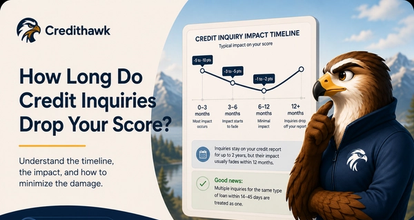
A hard pull will remain on your credit history for up to two years. But it won’t drop your credit score for two years. A single hard pull will typically drop your FICO® score by less than 5 points, though it depends on your individual credit profile. A thin file user with little or no credit history will be affected more by a hard inquiry.
Generally, the impact is felt for a year, with no drop after that, and a complete removal in two years. So a hard pull inquiry only drops your score by a small margin for 12 months, before it becomes score neutral. Under the Fair Credit Reporting Act (FCRA), hard pull inquiries have to be removed after 24 months.
The bottom line is that a single hard inquiry won't affect your credit score very much, and for a year on the FICO® scoring model (the most widely used). However, the situation becomes much more nuanced when you have multiple inquiries in a given time frame.
The Danger of Multiple Hard Pull Inquiries In a Short Time
While credit bureaus can seem purely mathematical and impersonal, they draw a lot based on behavioral research that is simple to understand. A person who applies for ten credit cards in a single week is likely to be one unable to repay. So it makes sense that multiple hard pull inquiries will not be viewed favorably by lenders.
How many is too many depends on where you are in your credit journey. For someone building from a thin file, even two or three hard pulls within a few months can cause a meaningful dip and signal more risk. For an established borrower with a higher score, the same number of inquiries carries far less weight (the system has more data to balance against it).
It further depends on your goals. If you are looking for a mortgage, it is often advised to have fewer credit applications a year in advance. But for established profiles (750+ FICO® Score),a high number of applications is less of a concern. It might drop in the short term (perhaps 15 to 30 points), but the impact is gone after a year and will ultimately result in an increased score as payments are made.
Exceptions: When Multiple Hard Inquiries Don’t Matter
The exception worth knowing is rate shopping for major loans. If you are comparing mortgage rates, auto loan offers, or student loan terms, FICO treats multiple inquiries within a 14 to 45-day window as a single event, recognizing that a consumer hunting for the best rate is exercising financial discipline, not desperation.
That protection does not extend to credit cards. Every credit card application triggers its own separate hard pull with its own score penalty, no matter how close together they fall. The practical rule: space credit card applications at least six months apart if you are in a building phase, and pause all new applications entirely for 12 months before applying for a mortgage or major loan.
Managing Hard Inquiries: A Simple Strategy for Every Credit Profile
The good news is that hard inquiries are one of the most manageable factors in your credit profile. A single pull is rarely worth worrying about, and even a handful of inquiries will fade from your score within 12 months.
The key is matching your pace to your current goals. If you are building credit, space out applications and treat each hard pull as a deliberate decision. If you are approaching a major purchase like a home or vehicle, protect your score by going quiet on new credit for at least a year beforehand.
And if you’re an established borrower optimizing rewards or credit lines, a short-term dip from multiple inquiries is a known and recoverable cost, not a crisis.
Daniel O'Keeffe
Financial Copywriter
Financial Copywriter. Bachelor of Laws (University of Limerick) & Masters in Computer Science (University College Dublin). Worked as junior consultant in J.P. Morgan (New York), State Street (Boston), RBS (London). Now interested in personal finance and geo-arbitrage of different kinds.