Identifying fit: How to Evaluate Starter Credit Products Safely
People with a thin credit profile (i.e. little to no credit history) generally won’t have access to premium products that offer the lowest rates and the most flexibility. However, there is a distinct category of starter credit products that can help newcomers to climb the credit ladder slowly and reliably.
They are designed for people with lower credit scores (typically below FICO score 580) or for those without any score whatsoever. The issue with this asset class is that it can attract low-quality providers, so due diligence quite important.
Some products offer bad terms that are not openly disclosed, or that are simply not a match to your specific financial position. It’s important to find the right fit, as opposed to taking the first offer that comes along.
Safe Research on Starter Credit Products
Financial institutions look at applications without a credit history as high risk. To offset this risk, they offer a distinct class of products with built in guardrails, such as higher initial deposits or steeper penalties for late payments.
This should not be seen as unfair practice, as it’s designed to safeguard lenders and give applicants the chance to establish a credit history. 6 to 12 months is a reasonable timeframe to build up a positive credit history of on-time, monthly payments.
This is achievable, but it’s important to complete some due diligence so you know that your credit activity is being reported and you’re not paying excessive fees. There are certain steps you can take to ensure the product is legitimate.
1. Ensure They Report To The Three Credit Bureaus
The first thing to ensure is that the starter credit product actively reports to the three credit agencies: Equifax, Experian, and TransUnion. Many providers might only report to one or two bureaus to cut down on costs. Or they might not report to all three providers every month.
What this means is that your credit is functionally useless for building out a credit profile. You could spend a year paying off a credit line that would still result in a blank profile when lenders pull your report.
2. Check The Fees And Costs
In a predatory practice known as fee harvesting, certain issues approve low limit cards with considerable upfront costs. For instance, you might get approval for a card with a $250 limit but has a $8 monthly fee and a $75 annual maintenance fee. This leaves you with very little credit and you have to pay just to keep the account open.
Safe starter credit products will have transparent fee structures with flat, refundable deposits. Make sure to check all fees and to compare the total credit limit to the annual and monthly fees.
3. Look For a Clear Graduation Pathway
Reputable providers will offer a clear pathway from your starter product to an intermediate product. Start credit products are not supposed to be a permanent feature. After 6 to 9 months, your account should be reviewed and you should graduate to a product with better terms and conditions, provided you have made payments on time.
For example, you might graduate from a secured, low limit card to an unsecured higher limit card (with your deposit refunded). If there is no pathway, what will happen is you will be locked into the lower line of credit indefinitely. Should you close your account, it will hurt your average credit age just to get your money back.
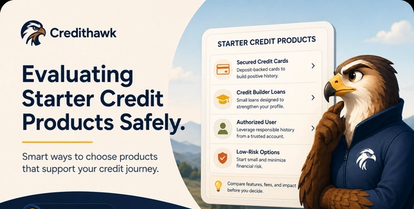
The Four Primary Starter Credit Options
There are four main avenues when it comes to starter credit products:
Secured Credit Cards: These are the default option for consumers with little or no credit history. You simply provide a refundable deposit (as low as $200) which acts as collateral and dictates your monthly spend. The lender faces no default risk because of the deposit. Approval rates are very high due to this. Just remember to avoid any annual fees or “processing” fees.
Credit Builder Loans: This is a popular option that doubles as both a strong credit builder and an automated savings mechanism. The lender places the loan (typically $500 to $2,000) into a locked savings account or Certificate of Deposit (CD). You make payments for 12 to 24 months and once the term ends the locked funds are released to you.
Alternatives Fintech Lines: Modern fintech companies can offer loans without looking at your credit score, but by purely analyzing your banking and payment data. This completely bypasses the hard pull inquiry and payments payments are often pulled automatically, which can help reduce the risk of late fees. These are valid and regulated providers, but you need to check the monthly subscription fee to see if it’s worth it.
Retail & Store Card: Retail credit cards (cards that can only be used at a specific clothing store, gas station, or electronics retailer) traditionally offer soft approval requirements for beginners. They provide a direct path to unsecured credit without requiring a cash deposit. However, they carry some of the highest interest rates in the financial industry, frequently exceeding 30% APR. On top of this, they tend to grant low initial limits, often around $100 to $300.
Designing Your Safe Starter Product Strategy
Selecting the right product comes down to matching your current assets with your timeline. If you have $200 in disposable savings that you can afford to leave untouched for 6 to 12 months, opening a zero-fee secured card from a major national bank could be the cleanest path forward.
If you lack liquid capital but have a steady, predictable income stream from your primary occupation, a credit-builder loan will establish your credit and help you to save automatically. Evaluate other choices carefully, ensuring that fees are clear and reporting is done to the three major agencies.
Remember that starter products are generally best treated as short-term tools. Make payments on time and your file should start to grow in 6 to 12 months, with a clear pathway to better credit and, therefore, improved financial offers.
Daniel O'Keeffe
Financial Copywriter
Financial Copywriter. Bachelor of Laws (University of Limerick) & Masters in Computer Science (University College Dublin). Worked as junior consultant in J.P. Morgan (New York), State Street (Boston), RBS (London). Now interested in personal finance and geo-arbitrage of different kinds.