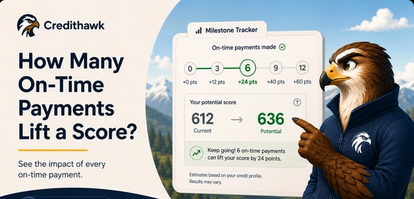
The Milestone Tracker: How Many On-Time Payments Lift a Score?
Building credit can be a confusing process if you don’t understand the system. Sometimes, you can make a payment and your credit score will stay the same or even drop.
This can happen for multiple reasons, the most common being that most credit card companies report to bureaus once a month, which might not capture the payment in that same month.
Yet even with these inconsistencies, making payments on time remains one of the most reliable methods to raise a credit score.
How Many On-Time Credit Payments Lift a Credit Score?
It's not really about how many on-time payments are made, but how many months of responsible payment history you build. Credit card companies typically report to the credit bureaus once a month, so making four payments within a single month generally isn't any better than making one on-time payment before the statement closes.
If you already have a credit score, even a single reported on-time payment can help strengthen your credit profile over time. However, if you're building credit from scratch, it generally takes about six months of credit history before you become eligible for your first FICO Score. Until then, you're effectively invisible to the primary FICO scoring model.
Once you have a score, the impact of on-time payments depends on your existing credit profile. Someone rebuilding after a missed payment may see noticeable improvements over several months of consistent payments, while someone who already has an excellent 800+ score is likely to see only small gains.
The Yearly Milestone For Better Credit Scores
While six months is enough to get you noticed, the 12-month marker is where you can start to see real benefits. You are less likely to be viewed as “high risk” and will benefit from two major shifts:
- Missed Payment Forgiveness: It’s true that a 30-day late payment stays on your report for seven years. What’s less known is that after 12 months of on-time payments, the weight of that missed payment drops considerably.
- Credit Increases: After a year, you may be eligible for credit limit increases. Major card issuers will often have automatic limit increases after a year. This results in a reduced credit utilization score, which automatically boosts your credit health.
Understanding the Credit Algorithm
Credit scoring models reward a long history of paying accounts as agreed. Every month that an account is reported in good standing adds another positive data point to your credit history. Over time, this consistent record helps strengthen your credit profile, while late payments can have the opposite effect.
It also helps to remember that credit scores can vary for many reasons. If you pay off a loan, then the account closes, which can hurt your credit mix and result in a temporary reduction. And even when you make payments, another factor such as a hard inquiry or an updated report from a different card can affect the overall score.
A good rule of thumb is to mostly ignore monthly, temporary drops and to look at scores on a quarterly and bi-annual basis. Your score could drop on a given month for a number of reasons, but it should certainly be moving upwards on a longer basis.
The Best Way to Manage Your Monthly Score
To get the biggest score boost from these milestones, you need to understand how the credit calendar works. Since most credit card companies only send your information to the bureaus once a month, timing is everything.
Many people think the goal is to pay every single credit card down to a zero balance before the statement closing date. However, if every card shows zero dollars spent, the credit algorithm might assume you are not using your credit at all. This can actually cause a small, temporary drop in your score.
To avoid this, you can use a simple strategy called "All Zero Except One (AZEO)":
- Pay off almost all of your credit cards completely before their monthly statement closing dates
- Leave just one card with a very small balance ($5 to $10) when its statement closes.
- As soon as you get the monthly bill showing that small balance, pay it off completely before the due date.
This simple strategy shows the credit bureaus that you are responsibly using your credit, without letting a high balance drag your score down.
Good Credit Building Habits
At the end of the day, building great credit is less about complex math and more about creating good habits. You do not need to stress over daily changes or try to trick the system with weekly payments.
By focusing on your six-month and twelve-month milestones, keeping your monthly balances low, and making sure you never miss a due date, your credit score is likely to improve over time.
For those new to credit, there are starter options with low limits (such as $200) that are easy to repay and highly accessible. The payment amount is not as important as the ability to make payments on time.
Daniel O'Keeffe
Financial Copywriter
Financial Copywriter. Bachelor of Laws (University of Limerick) & Masters in Computer Science (University College Dublin). Worked as junior consultant in J.P. Morgan (New York), State Street (Boston), RBS (London). Now interested in personal finance and geo-arbitrage of different kinds.