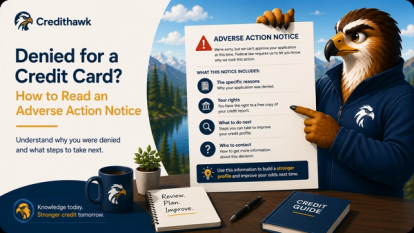
Denied for a Credit Card? How to Read an Adverse Action Notice
Getting denied for a credit card can be a frustrating experience. However, federal law requires that the reasons for the denial be disclosed. If you’ve been refused, or are approved on significantly less favorable terms, then you should receive an adverse action notice.
This explains the main reasons behind the denial, which is valuable data if you assess it correctly and take the next steps to improving your credit health. Remember that getting denied does not automatically mean you’re a high-risk borrower.
What Is an Adverse Action Notice?
Under federal law, specifically the Equal Credit Opportunity Act (ECOA) and the Fair Credit Reporting Act (FCRA), lenders are legally required to provide a written explanation whenever they take "adverse action" against a consumer. Taking adverse action can include denying a new credit card application, refusing to grant a credit limit increase, or closing an existing account.
The primary purpose of this law is transparency. It ensures that credit decisions are grounded in objective data, protects consumers against unlawful discrimination, and ensures you know exactly which credit factors are holding your profile back. By law, a credit card issuer must send you an adverse action notice within 30 days of making their decision.
The Four Components of an Adverse Action Notice
While the exact layout might be different, your adverse action notice will always have four primary components.
#1. The Specific Reasons for the Denial
This is one of the most important elements of the notice as the word “specific” prevents vague statements. You will see statements like “credit utilization ratio is too high" or "too many recent hard inquiries on credit file". This provides precise guidance on the areas that you need to work on. You can usually expect to see between one and four explicit statements on the report.
#2. Credit Score and Credit Bureau Details
Almost all credit card companies use a credit score to make their decisions. And they must disclose the exact score they used. This section will detail the score, the date it was pulled, and the specific bureau (Equifax, Experian, TransUnion, or a minor bureau).
#3. Free Copy of Your Credit Report
Because an adverse action occurred, you are entitled to a free credit report from the bureau that supplied the lender with your data. You have 60 days to request this report. You can also pull a free report from each of the three bureaus on a weekly basis, at the current time. This is not federally mandated, just something the bureaus started to do through AnnualCreditReport.com.
The difference is that this copy is the one the lenders used to refuse an application at a specific point in time. This eliminates any guesswork about what led to the denial
#4. Statement of Your FCRA and ECOA Rights
The notice will conclude with standardized regulatory language explaining your rights to dispute inaccurate or incomplete information on your credit report. It will also outline how to contact the relevant government regulatory agency (such as the Consumer Financial Protection Bureau) if you suspect unfair treatment.
Taking Action on Your Adverse Action Notice
Once you have read your notice, you can use it to take action and improve your profile.
- Claim Your Free Credit Report Immediately: Use the contact information provided in the notice to request your credit report. Review every single line item carefully. Look for incorrect balances, late payments that were actually made on time, or old collection accounts that should have naturally aged off your file.
- Dispute Any Inaccurate Information: If you discover errors or fraudulent activity on the report that contributed to your denial, file a formal dispute directly with the credit bureau. By law, the bureau generally has 30 days to investigate and correct verified errors.
- Target the Top Denial Reasons: Treat the listed denial reasons as your personalized checklist. If the notice cites high utilization, focus your cash flow on paying down existing card balances. If it cites a thin history, give your existing accounts time to mature before applying again.
- Call the Reconsideration Line: In some cases, a denial is caused by a minor administrative issue, such as an unverified address or a recent card balance payment that hasn't been updated on your report yet. You can call the bank's reconsideration line to speak with an underwriter and ask them to manually review your application.
Using The Adverse Action Notice to Your Advantage
When you’re looking forward to a shiny metal card and instead get hit with a legal notice, it can feel like a blow to the stomach.
But this is invaluable information, if you use it in the right way. It’s a precise snapshot in terms of what lenders look at and why they refused your credit application, with a direct path to a resolution.
You can get to work on addressing these issues right away, or start looking for offers that are more in line with your existing credit profile.
Daniel O'Keeffe
Financial Copywriter
Financial Copywriter. Bachelor of Laws (University of Limerick) & Masters in Computer Science (University College Dublin). Worked as junior consultant in J.P. Morgan (New York), State Street (Boston), RBS (London). Now interested in personal finance and geo-arbitrage of different kinds.