Credit Score Ranges Explained: What Counts as Good Credit?
The answer as to what counts as a “good” credit score is not always straightforward. This is because it can depend on the specific offer you’re applying for.
A score of 680 might seem strong until a financial website indicates that a score of 720 is the minimum required credit. Another issue is that there are different scoring algorithms and even industry-specific algorithms.
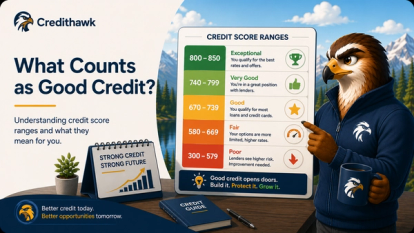
Thankfully, there are official scoring ranges as demonstrated by both FICO and VantageScore, the two foremost models. Both scores range from 300 to 850. And both scoring ranges break it down into five categories.
Official FICO Credit Score Ranges
FICO is the most widely used and the oldest scoring model in the U.S.:
- Exceptional (800 to 850): This is the platinum standard. You qualify for the lowest possible interest rates, maximum credit card rewards, and premium loan terms. Lenders will even compete for your business, not the other way around.
- Very Good (740 to 799): You are considered a highly competitive, low-risk borrower. You will easily qualify for a vast majority of credit cards, auto loans, and mortgages with highly favorable interest rates.
- Good (670 to 739): This is the safe zone and represents the national average baseline. While you might not qualify for the absolute lowest promotional rates, you will still secure solid approvals with respectable terms.
- Fair (580 to 669): This represents a transition tier. You may face higher interest rates, lower initial credit lines, or require a co-signer. Approvals are common, but borrowing money will cost you more over time.
- Poor (300 to 579): You are in the rebuilding stage. Traditional approvals are tough to secure. You may need to rely on secured credit cards, utility deposit waivers, or dedicated credit-builder loans to establish a new history.
Official VantageScore Credit Ranges
VantageScore was created by the three major credit bureaus to introduce a more modern and inclusive scoring methodology. It uses the following tiers:
- Excellent (781 to 850): You have earned top-tier status. Lenders offer their best promotional terms, lowest rates, and highest credit limits to profiles in this bracket.
- Good (661 to 780): You are a prime borrower. This broad tier offers a strong rate-shopping landscape, giving you easy access to competitive credit cards and traditional financing options.
- Fair (601 to 660): You are in the near-prime baseline. You can expect reliable approvals, but interest rates will be slightly elevated compared to higher tiers.
- Poor (500 to 600): This is a subprime designation. Borrowing is more restrictive, and options will frequently come with higher fee structures or require collateral.
- Very Poor (300 to 499): This is the deep subprime foundation. Focus is placed on credit restoration, utilizing specialized credit-builder tools to establish a consistent payment track record.
What Exactly Counts as a "Good" Credit Score?
If you’re looking for a singular target to shoot for, a FICO score of 670 or higher or a VantageScore of 661 or higher is generally where credit is officially considered "Good" by lenders.
Crossing this threshold is a significant milestone on your financial journey. Once your profile steps into the "Good" range, you transition from simply trying to get approved for credit to having the leverage to select options with competitive terms.
However, keep in mind that every lender maintains its own internal guidelines. A credit card issuer might consider a 680 score high enough to unlock their top-tier cashback card, while a mortgage lender navigating a tighter economic environment might reserve their absolute best rates for borrowers sitting comfortably above 740.
When a Credit Score is Not Enough
The credit score is a succinct three-digit snapshot of your credit history, created from multiple financial data points. And it’s the figure you want to focus on improving over time. It will help you get better terms, favorable housing options, and a waiver on security deposits (in some cases).
But it’s equally important to remember that it’s not the only thing that lenders will focus on. Particularly for larger loans (such as a mortgage), a lender will look at other elements in great detail, including income, debt obligations, and employment history.
In many ways, the credit score can be likened to a CV. It provides a quick summary of your financial history, but it is only one part of the overall picture. Just as employers look beyond a résumé before making a hiring decision, lenders consider additional information before approving many types of credit.
Focus on Progress, Not a Perfect Number
Credit score ranges provide useful benchmarks, but they should not be viewed as fixed targets. A score that is considered strong today may not qualify for every financial product, while a lower score may still be enough for many credit cards, auto loans, or rental applications.
The most important goal is building healthy long-term habits. Paying your bills on time, keeping balances low, and avoiding unnecessary applications will steadily improve your credit profile regardless of which scoring model a lender uses.
Over time, those habits matter far more than chasing a specific three-digit number.
Daniel O'Keeffe
Financial Copywriter
Financial Copywriter. Bachelor of Laws (University of Limerick) & Masters in Computer Science (University College Dublin). Worked as junior consultant in J.P. Morgan (New York), State Street (Boston), RBS (London). Now interested in personal finance and geo-arbitrage of different kinds.