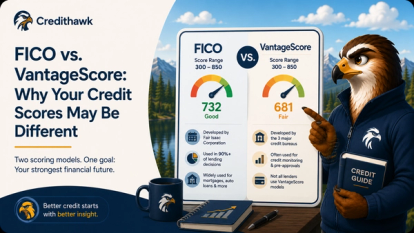
FICO vs. VantageScore: Why Your Credit Scores May Be Different
If you check your credit scores across multiple apps, you might come across something confusing. One app could indicate a score of 520, another a score of 580. So, which one is the “real” one?
The short answer is that both scores are technically correct. Different scoring models (such as FICO and VantageScore) use different formulas to interpret the same credit information. As a result, it's perfectly normal to see different scores.
This is the primary reason for having different scores, though other criteria can also factor in.
Two Different Models With Different Credit Outcomes
Think of your credit history as a student's report card. FICO and VantageScore are like two professors grading the same work. Because each uses a different grading system, it's possible to arrive at slightly different final grades.
The scoring range is the same, 300 to 850, with 850 being the highest and 300 being the lowest. Despite the different methods, the differences in score are likely to be small, typically 10 to 30 points. This reflects the idea that you can arrive at similar conclusions based on different methods.It’s also possible not to have a credit score in the first place.
FICO, created in 1989, is by far the biggest player in the industry, but VantageScore has been gaining ground in recent years. VantageScore was created in 2006 by the three credit bureaus (Experian, TransUnion, Equifax).
Why Credit Scores Can Diverge Across Models
To understand why scores may be different, it helps to see what each model places emphasis on. Neither model releases their exact formula, but they do publish what the overall score is made from on a macro level.
Breaking Down the FICO Methodology
FICO score calculations takes a percentage-based model when it comes to assessing risk, with a focus on five categories:
- Payment History (35%): Whether you pay your bills on time.
- Amounts Owed / Credit Utilization (30%): How much of your available credit limit you actively use.
- Length of Credit History (15%): The average age of your accounts.
- New Credit (10%): Recent hard inquiries and newly opened lines.
- Credit Mix (10%): The variety of your accounts (e.g., credit cards, auto loans, mortgages).
In this manner, consumers can understand that payment history should be given more priority than credit mix or new credit. But there is never a way to understand what exactly makes for a good rating within these categories, as that is a confidential algorithmic formula.
Breaking Down the VantageScore Methodology
VantageScore does not rely on specific percentages to calculate credit scores. Instead, it has a hierarchical level of importance on certain categories.
- Extremely Influential: Payment history (whether you pay your bills on time).
- Highly Influential: Total credit usage (how much of your available credit limit you actively use).
- Highly Influential: Credit mix and experience (the variety of your accounts and the length of your credit history).
- Moderately Influential: New accounts opened (recently opened credit accounts and new credit applications).
- Less Influential: Balance and available credit (your overall balances and the amount of unused credit available to you).
Like FICO, VantageScore will also have different scoring models, designed for specific lending categories, as well as newer models to keep aligned with market updates and new trends.
Other Reasons Why Scores May Not be Identical
Aside from the two big credit scoring models, there are other reasons as to why your credit score might be reported differently across platforms.
#1. Credit File Thickness
It’s possible to get a credit score from VantageScore within 30 days. But with FICO, in the majority of cases, it will take six months. This means you could have a VantageScore rating but no FICO credit score.
#2. Treatment of Collection Accounts
Both models penalize late payments, but they view collection data through different lenses. Modern VantageScore models completely ignore collection accounts once they have been paid in full. Older FICO models—which many lenders still use—keep paid collections on your record, factoring them negatively into your final score until they naturally age off.
#3. Multiple Inquiries and "Rate Shopping"
When you shop for a major loan, like a mortgage or an auto loan, lenders trigger ‘hard inquiries’ to view your file. Both models group multiple inquiries together so you aren't penalized for shopping around for a good interest rate. However, their timelines differ. FICO groups inquiries within a 45-day window, whereas VantageScore rolls all inquiries of a similar loan type into a tight 14-day window.
#4. Different Datasets
Although FICO and VantageScore can both use information from Experian, Equifax and TransUnion, not every lender reports information to all three bureaus. If two apps calculate your score using reports from different bureaus, even small differences in the underlying data can produce different scores
How to Improve On Both Models
While these are technically different models, the scores will ultimately not diverge too much, in the majority of cases. Making payments on time, the golden rule of credit, will improve both scores. You’ll also want to keep your credit balances low, maintain older accounts instead of closing, avoid applying for many new credit lines in a short time period (with a few notable exceptions, such as rate shopping).
Another thing you’ll want to consider is checking your credit score regularly, at very least on a quarterly basis. This helps you to spot and dispute errors on your report. The reporting bureaus are legally obligated to investigate errors within 30 days and to remove incorrect information. A reporting error can affect your score if a bad actor is applying on your behalf.
It’s Natural to Have Different Credit Scores
Remember that having different credit scores isn’t a cause for concern. It’s something that can often trip new users up, as they think they are doing something “wrong” or they get frustrated that they can’t get a handle on how the scores are applied.
By building strong financial habits and avoiding simple errors (like closing older credit accounts), all models should show a steady improvement over time.
As your credit profile becomes healthier with time, both of the major models should start to reflect this information, with a consistent upward trend.
Daniel O'Keeffe
Financial Copywriter
Financial Copywriter. Bachelor of Laws (University of Limerick) & Masters in Computer Science (University College Dublin). Worked as junior consultant in J.P. Morgan (New York), State Street (Boston), RBS (London). Now interested in personal finance and geo-arbitrage of different kinds.